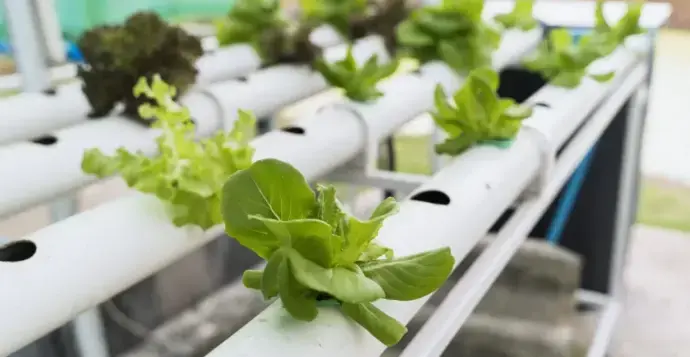
Germination is the most important stage in a plant’s life, determining its vigor, health, and future productivity. Many beginners make common mistakes that affect success rates, such as keeping seeds too wet, failing to control temperature, or exposing them to light too early. For this reason, the use of phenolic foam or agricultural foam has become a modern, clean, and reliable technique suitable for all types of plants, from vegetables and herbs to ornamentals.
These foams provide physical support, uniform moisture retention, root oxygenation, and easier seedling handling, especially when transplanting into hydroponic systems.
Preparing the Foam and Selecting Seeds
Types of foam:
Phenolic foam with uniform and stable density, ideal for delicate or small seeds.
Agricultural foam that is porous, lightweight, and has excellent water retention, suitable for medium or more resilient seeds.
Preparation steps:
Cut the foam into cubes or blocks sized according to the seed, 1 to 3 centimeters for small seeds and 4 to 5 centimeters for larger seeds.
Sterilize by soaking in a 0.5 percent sodium hypochlorite solution for 10 minutes, then rinse with clean water.
Saturate the foam with water or diluted nutrient solution until moist but not waterlogged.
Seed selection:
Choose firm, intact seeds without spots.
For hard seeds, consider pre soaking, scarification, or thermal treatment depending on the species.
Avoid damaged seeds or those showing signs of disease.
Step by Step Germination Process
Sowing:
Place one seed per foam block to prevent competition.
Lightly cover if required by the species, while some seeds must remain on the surface and receive light.
Germination conditions:
Darkness is important for many seeds during the first 3 to 7 days depending on species. Premature light can inhibit early growth.
Maintain temperature between 68 and 82 degrees Fahrenheit depending on species.
Keep moisture constant without oversaturation. A humidity dome or clear plastic cover can help.
After sprouting, gradually introduce indirect light, followed by natural sunlight or LED lighting.
Approximate germination times:
Small vegetable seeds 4 to 10 days
Herbs 7 to 14 days
Medium or hard seeds 10 to 21 days
Some large ornamental seeds up to 30 days
Daily maintenance:
Check moisture daily and add water if the foam begins to dry.
Avoid excess water to prevent fungal growth and rot.
Ventilate the humidity dome to reduce mold.
Seedling development:
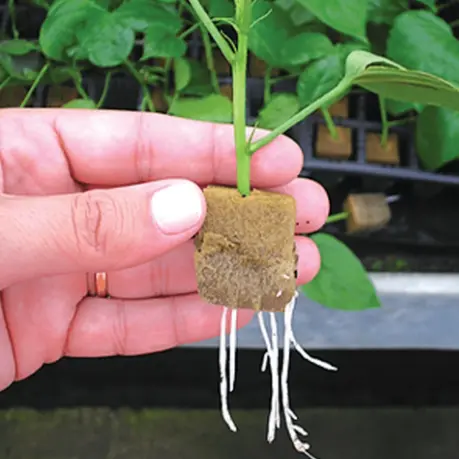
Seedlings are ready for transplant when cotyledons are firm and roots are visible.
Roots should be white and healthy, not overly long or tangled.
Transplanting to a Hydroponic System
System preparation:
Clean and disinfect trays, NFT channels, reservoirs, or floating systems.
Adjust pH between 5.5 and 6.5 and set electrical conductivity according to species.
Prepare a diluted starter nutrient solution to reduce transplant shock.
Placing the seedling:
Carefully insert the foam block into the hydroponic system.
Ensure roots contact the nutrient solution without damaging the shoot.
Initial adaptation:
Maintain controlled humidity and temperature for the first two to three days.
Avoid intense direct light until fully adapted.
Watch for stress signs such as wilting leaves, weak shoots, or darkened roots.
Ongoing care:
Maintain consistent water and oxygen flow in NFT systems or uniform irrigation in substrate systems.
Adjust fertilization according to growth stage and species.
Implement preventive pest and fungal management.
Practical Tips for Beginners
Use uniform block sizes for all seeds.
Never sow multiple seeds in the same block.
Always sterilize foam and water before germination.
Record temperature, humidity, and pH daily to replicate successful results.
Gradually acclimate seedlings to stronger light and more concentrated nutrient solution.
Inspect roots and cotyledons before transplanting to ensure vigorous plants.
Using phenolic foam and agricultural foam provides a healthy start for any plant, increasing germination rates, seedling uniformity, and survival after transplanting into hydroponic systems. Maintaining controlled moisture, temperature, initial darkness, and gradual light exposure is essential for producing strong plants ready for optimal growth.
This technique not only improves seedling quality but also optimizes resources, reduces disease losses, and supports professional crop management. For any grower, beginner or advanced, foam based germination is a strategic tool that ensures productivity, uniformity, and success in hydroponic gardening.
We hope this was helpful.
Would you like to suggest the next topic Leave us a comment.
See you next time.